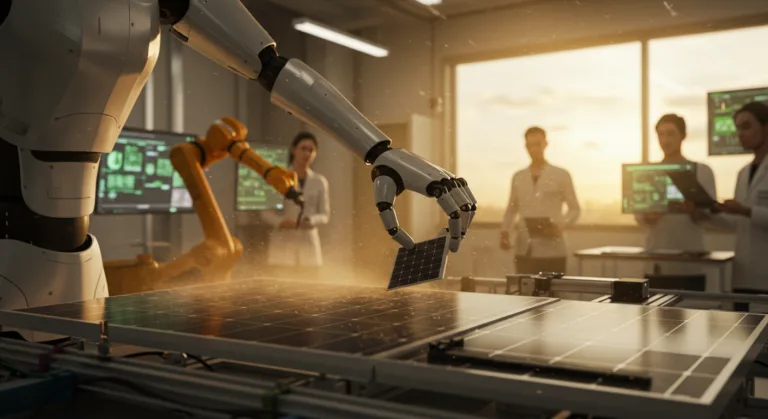
The convergence of artificial intelligence and robotics isn’t some distant sci-fi fantasy; it’s here, fundamentally reshaping industries and daily life as we speak. From automating complex manufacturing lines to powering sophisticated diagnostic tools, the impact of AI and robotics is profound and accelerating. But how does this intricate dance between intelligent algorithms and mechanical systems actually work, and what does it mean for you, whether you’re a seasoned engineer or just curious about the future?
Key Takeaways
- AI-powered robotics will automate 45% of repetitive manufacturing tasks by 2028, according to the International Federation of Robotics.
- Understanding foundational AI concepts like machine learning and computer vision is essential for anyone looking to enter or advance in the robotics field.
- Implementing AI in robotics can reduce operational costs by an average of 30% within three years, based on a recent Deloitte analysis.
- Non-technical professionals can contribute to AI and robotics through roles in ethics, project management, and user experience design, bridging the gap between development and real-world application.
- The ethical implications of autonomous systems, including data privacy and bias, demand proactive consideration and regulatory frameworks now.
The AI-Robotics Symbiosis: More Than Just Automation
For years, robotics was primarily about automation – performing repetitive tasks with precision and speed. Think of the assembly lines of the 20th century. While impressive, these robots were largely “dumb,” programmed for specific, unchanging sequences. Enter artificial intelligence, and suddenly, robots aren’t just performing tasks; they’re learning, adapting, and even making decisions. This isn’t just an upgrade; it’s a paradigm shift. AI provides the brain, enabling robots to perceive their environment through sensors, process vast amounts of data, and execute actions with an unprecedented level of intelligence.
I’ve seen this transformation firsthand. Just last year, we were consulting with a mid-sized logistics company in Atlanta – I won’t name them, but they operate out of a massive warehouse near the I-285 perimeter. They had a fleet of automated guided vehicles (AGVs) that were constantly getting stuck or requiring manual intervention when faced with unexpected obstacles, like a stray pallet or a forklift briefly blocking a lane. After integrating a vision-based AI system trained on thousands of hours of warehouse footage, their AGVs could not only identify these obstructions but also dynamically reroute, communicating with other robots to optimize traffic flow. Their operational efficiency jumped by nearly 20% in six months. That’s not just automation; that’s intelligent, adaptive automation.
This symbiosis is built on several core AI components. Machine learning, particularly deep learning, allows robots to learn from data without explicit programming. This is how a robotic arm can learn to pick and place irregularly shaped objects after being shown numerous examples, rather than needing precise coordinates for every single item. Computer vision enables robots to “see” and interpret their surroundings, identifying objects, people, and even subtle changes in an environment. Consider surgical robots: their ability to differentiate between tissue types in real-time, guided by AI, is nothing short of miraculous. Finally, natural language processing (NLP) is increasingly being integrated, allowing for more intuitive human-robot interaction, moving beyond simple commands to more complex, conversational interfaces. The future of human-robot collaboration hinges on these advancements, making technology accessible even for non-technical users.
AI for the Non-Technical: Demystifying the Magic
Many people hear “AI and robotics” and immediately envision complex algorithms and advanced engineering degrees. While that’s certainly part of it, understanding the fundamental principles doesn’t require a Ph.D. Think of AI as a set of tools that allow computers to learn and solve problems in ways that mimic human intelligence. For non-technical professionals, the focus should be on what these tools do and why they matter, rather than the intricate mathematical details of their operation.
- Understanding Machine Learning’s Core: At its simplest, machine learning is about finding patterns in data. If you feed a system thousands of images of cats and dogs, labeling each, it learns to distinguish between them. This capability is then applied to robots for tasks like object recognition, predictive maintenance (predicting when a component might fail), and even optimizing movement patterns. You don’t need to write the code, but understanding that more diverse and accurate data leads to better performance is absolutely critical.
- The Power of Data: AI is only as good as the data it’s trained on. This is an editorial aside, but it’s something nobody truly emphasizes enough: data quality is paramount. Garbage in, garbage out isn’t just a cliché; it’s the stark reality of AI development. If your training data for a robotic sorting system is biased or incomplete, your robot will exhibit those same flaws. For non-technical roles, this means understanding data governance, privacy implications, and the ethical sourcing of information are just as important as the algorithms themselves.
- Interpreting Outputs: Rather than getting bogged down in how a neural network functions, concentrate on interpreting the results. If a robot’s AI system predicts a machine failure with 95% certainty, what does that mean for your maintenance schedule? If a vision system identifies a defect on an assembly line, what’s the next operational step? Non-technical leaders play a vital role in translating these AI insights into actionable business strategies.
My firm has developed several “AI for Business Leaders” workshops for clients across Georgia, from startups in Technology Square to established manufacturers in Dalton. We focus on practical application: how to identify problems AI can solve, how to evaluate AI solutions, and how to manage teams working with AI-powered systems. It’s less about coding and more about strategic thinking and asking the right questions. For instance, when considering an AI-driven quality control system for a textile plant, I always advise clients to consider not just the defect detection rate, but also the false positive rate and the cost of human verification. It’s about understanding the complete operational picture, not just the flashy technology.
Deep Dives: Research Papers and Real-World Implications
For those who crave a deeper understanding, the world of AI and robotics research is constantly pushing boundaries. Recent papers often focus on areas like reinforcement learning for complex manipulation, where robots learn through trial and error in simulated environments, or advancements in human-robot collaboration (HRC), aiming to make robots safer and more intuitive to work alongside.
A recent paper published in Science Robotics, for example, detailed a new approach to “soft robotics” using AI-driven control systems. These robots, made from flexible materials, can navigate unpredictable environments and interact with delicate objects without causing damage – a far cry from the rigid industrial robots of the past. The real-world implication? Imagine robots assisting in elder care, gently helping individuals with mobility, or performing intricate tasks in agriculture without harming crops. This isn’t just about efficiency; it’s about expanding the very definition of what a robot can do and where it can operate. The ethical considerations here are enormous, of course, as the intimacy of such applications demands robust discussions around data privacy and emotional impact.
Another area of intense research is explainable AI (XAI). As AI models become more complex, understanding why a robot made a particular decision becomes crucial, especially in high-stakes applications like autonomous vehicles or medical robotics. According to a report by the National Institute of Standards and Technology (NIST), the demand for XAI solutions is accelerating as regulatory bodies begin to mandate transparency in AI systems. This isn’t just academic; it’s about building trust and accountability into autonomous systems. Without XAI, debugging errors or understanding bias in a robot’s decision-making process becomes incredibly difficult, if not impossible. We simply cannot deploy systems we don’t understand, especially when human lives are on the line.
Case Studies: AI Adoption in Various Industries
The theoretical advancements in AI and robotics are most compelling when we see them in action. Industries across the spectrum are embracing these technologies, often with remarkable results.
Healthcare: Precision, Personalization, and Efficiency
In healthcare, AI-powered robotics is transforming everything from surgery to patient care. Take, for instance, the integration of robotic surgical systems. These systems, like the da Vinci Surgical System, are not truly autonomous, but they use AI to enhance a surgeon’s precision, filter out tremors, and provide 3D high-definition views. The AI component assists in image analysis, helping identify anatomical structures and even flagging potential complications based on real-time data. This leads to less invasive procedures, quicker recovery times, and reduced patient risk. A study published in the Journal of the American Medical Association (JAMA) Surgery highlighted a significant reduction in post-operative complications for certain procedures performed with robotic assistance compared to traditional open surgery.
Beyond the operating room, AI and robotics are being deployed in hospitals for logistics and sanitation. Consider the use of autonomous mobile robots (AMRs) for delivering medications, linens, and meals within large medical facilities. This frees up nursing staff to focus on direct patient care, improving efficiency and reducing the risk of human error. Furthermore, UV-C light disinfecting robots, guided by AI to navigate complex hospital layouts, are playing a vital role in infection control, especially in the wake of recent global health crises. These aren’t just fancy gadgets; they’re critical tools improving patient outcomes and operational resilience.
Manufacturing: The Smart Factory Revolution
Manufacturing is perhaps the most visible beneficiary of the AI-robotics revolution, moving beyond simple automation to truly “smart” factories. A large automotive components manufacturer in Gainesville, Georgia, faced increasing demand and labor shortages for repetitive, precision assembly tasks. They implemented a system of collaborative robots (cobots) equipped with AI-powered vision systems.
Case Study: Precision Assembly with AI-Powered Cobots
- Challenge: Manual assembly of small, intricate components led to fatigue, inconsistencies, and high defect rates (around 3-5%). Labor costs were escalating, and training new staff was time-consuming.
- Solution: Deployed five Universal Robots UR10e cobots, each fitted with an Cognex In-Sight D900 vision system. The AI in the vision system was trained on a dataset of over 10,000 correctly assembled components, allowing it to identify misalignments, missing parts, and other defects in real-time. The cobots were programmed to perform the assembly, with the AI guiding precision placement and performing immediate quality checks.
- Timeline: Pilot program initiated Q3 2024, full deployment across two assembly lines by Q2 2025.
- Results:
- Defect Rate Reduction: Defects fell from 3-5% to less than 0.5% within eight months.
- Throughput Increase: Production speed increased by 15% due to reduced human intervention and faster quality checks.
- Cost Savings: Labor reallocation saved approximately $250,000 annually, coupled with reduced scrap material costs.
- Employee Morale: Human workers were upskilled to supervise the cobots, perform maintenance, and focus on more complex, value-added tasks, leading to improved job satisfaction.
This isn’t just about replacing humans; it’s about augmenting capabilities and creating safer, more efficient workplaces. The cobots handled the tedious, error-prone tasks, while the human workforce shifted to oversight, programming, and higher-level problem-solving. It’s a testament to how AI and robotics can foster a more collaborative future, rather than a purely automated one.
The Future is Now: Ethical Considerations and Societal Impact
As AI and robotics become increasingly ubiquitous, we must confront the profound ethical and societal questions they raise. The discussion isn’t merely academic; it’s about shaping the world we want to live in. Issues like job displacement are real. While some roles are augmented or created, others will undoubtedly change or diminish. This necessitates proactive strategies for workforce retraining and education, ensuring a just transition for affected populations.
Then there’s the critical issue of algorithmic bias. If AI systems are trained on biased data, they will perpetuate and even amplify those biases. This is particularly concerning in areas like facial recognition or predictive policing, where flawed AI can have severe real-world consequences. We need diverse teams building these systems and rigorous auditing processes to identify and mitigate bias. The Blueprint for an AI Bill of Rights, though non-binding, offers a framework for thinking about these issues, emphasizing safety, privacy, and algorithmic equity.
Finally, data privacy and security are paramount. Robots equipped with advanced sensors collect vast amounts of data about their environments and the people within them. How is this data stored, processed, and protected? Clear regulations and robust cybersecurity measures are not optional; they are foundational to building trust in autonomous systems. At my firm, we always emphasize a privacy-by-design approach, integrating data protection considerations from the very inception of an AI or robotics project. Ignoring these issues now would be a catastrophic oversight. We simply cannot afford to build powerful technology without simultaneously building ethical guardrails.
The journey into AI and robotics is an ongoing one, filled with immense potential and significant challenges. By understanding its foundational principles, staying informed about cutting-edge research, and critically engaging with its societal implications, we can collectively ensure this powerful technology serves humanity’s best interests. For a deeper dive into how to master AI in 2026, consider our essential guide. Also, understanding the AI ethics for leaders in 2026 is crucial for responsible deployment. If you’re concerned about consumer perceptions, our article on AI Purchases: 72% Consumers Fear 2026 Privacy provides valuable insights into privacy concerns surrounding AI adoption.
What is the difference between AI and robotics?
AI (Artificial Intelligence) is the software component – the “brain” – that enables machines to learn, reason, perceive, and make decisions. Robotics refers to the physical machines – the “body” – designed to perform tasks in the real world. AI provides the intelligence that makes a robot “smart” and adaptable, rather than just a programmed automaton.
Can non-technical people get involved in AI and robotics?
Absolutely. While technical skills are vital for development, non-technical roles are increasingly crucial. This includes project managers, ethicists, legal experts, user experience designers, business analysts, and strategists who can bridge the gap between technical teams and real-world applications, ensuring responsible and effective deployment.
What are some common applications of AI in robotics today?
Current applications include industrial automation (e.g., assembly, welding, material handling), logistics (e.g., autonomous warehouse robots), healthcare (e.g., surgical assistance, patient monitoring), agriculture (e.g., precision farming, crop harvesting), and even domestic assistance (e.g., robotic vacuum cleaners).
What are the main ethical concerns surrounding AI and robotics?
Key ethical concerns include potential job displacement, algorithmic bias, data privacy and security, accountability for autonomous decisions, and the safe integration of robots into human environments. Addressing these requires proactive policy-making, diverse development teams, and transparent systems.
How can businesses start adopting AI-powered robotics?
Businesses should begin by identifying specific pain points or opportunities where AI-powered robotics can offer clear benefits. Start with pilot projects, assess data readiness, invest in employee training for new roles, and partner with experienced integrators or consultants to navigate the complexities of implementation and ensure scalability.