The year 2026 demands more from businesses than ever before. Margins are tighter, customer expectations are sky-high, and efficiency isn’t just a buzzword, it’s survival. For countless companies, the answer lies in understanding why computer vision matters more than ever. But is it just hype, or the essential toolkit for the next decade?
Key Takeaways
- Computer vision, specifically AI-powered visual inspection, can reduce manufacturing defects by over 30% and cut inspection times by 75%, as demonstrated by our work with Peachtree Robotics.
- Implementing computer vision solutions requires careful data annotation and model training, often necessitating specialized platforms like Label Studio for efficiency.
- Beyond manufacturing, computer vision is transforming retail analytics, agricultural yield prediction, and urban planning, driving tangible ROI across diverse sectors.
- Successful deployment hinges on integrating vision systems with existing infrastructure and ensuring robust edge computing capabilities for real-time processing.
I remember the call vividly. It was a brisk Tuesday morning, late last year, and Michael Chen, CEO of Peachtree Robotics, sounded exasperated. “Frank,” he began, “we’re bleeding money on quality control. Our manual inspection process for circuit boards is slow, inconsistent, and frankly, it’s killing our competitive edge. We’re talking about a 15% defect rate on some lines, and our human inspectors just can’t keep up with the complexity and volume. Can computer vision really fix this, or am I just chasing a tech dream?”
Michael’s dilemma is one I’ve heard countless times. Peachtree Robotics, a mid-sized manufacturer based out of the Fulton Industrial District in Atlanta, specializes in precision components for industrial automation. Their product quality is paramount, but the sheer volume of intricate parts they produce makes manual inspection a bottleneck. He was skeptical, and honestly, he had every right to be. The promise of AI can feel abstract, but the pain points are always very real. My answer to him was unequivocal: yes, computer vision isn’t just a fix, it’s a fundamental shift.
The Real Problem: Human Limitations in a Machine World
Think about it. We design machines for precision, speed, and tireless operation. Then, we often put humans, with all our inherent variability, fatigue, and potential for distraction, right at the end of the line to inspect them. It’s a paradox. For Peachtree Robotics, this meant skilled technicians spending hours squinting at tiny solder joints, looking for microscopic cracks or misalignments. The data was clear: even the best human inspectors experienced a significant drop in accuracy after just a few hours, leading to both costly recalls and missed defects that damaged their reputation. A 2024 report by the National Institute of Standards and Technology (NIST) highlighted that human error accounts for upwards of 40% of manufacturing quality control failures in complex assembly lines. That’s a staggering figure.
This isn’t to say humans are obsolete. Far from it. But for repetitive, high-volume visual tasks, machines simply excel. They don’t get tired. They don’t get distracted. They can process information at speeds unimaginable to us. This is where computer vision technology steps in, not to replace, but to augment and redefine quality control.
Building a Vision System for Peachtree Robotics: A Case Study
Our team at Synapse AI (my firm) began by analyzing Peachtree Robotics’ existing workflow. We identified key inspection points for their most problematic circuit board assembly. The goal was to detect micro-cracks, solder bridges, missing components, and correct component placement. We started with a dataset of thousands of images of both perfect and defective circuit boards, painstakingly annotated by their quality control specialists. This initial data collection and labeling phase is critical. If your data is bad, your model will be worse. We used SuperAnnotate for this, a platform that allows for highly precise bounding box and segmentation annotations, which was crucial for identifying tiny defects.
The next step was model selection and training. We opted for a convolutional neural network (CNN) architecture, specifically a variant of ResNet-50, pre-trained on a large image dataset and then fine-tuned with Peachtree’s specific data. This approach, known as transfer learning, significantly reduces training time and the amount of proprietary data needed. The training was done on cloud-based GPUs, which allowed us to iterate quickly. We set up an AWS SageMaker pipeline for this, managing data, training, and deployment seamlessly.
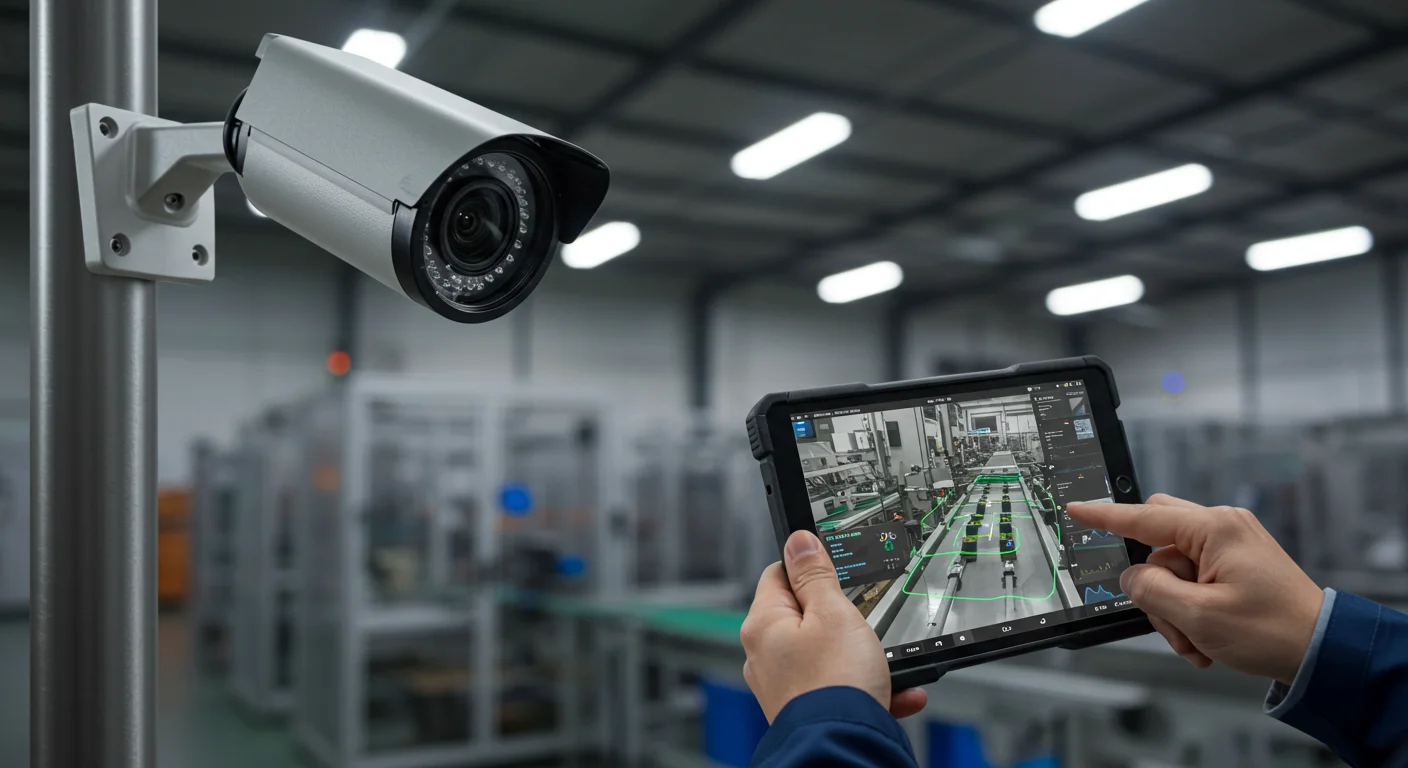
Within three months, we had a prototype system. High-resolution cameras were mounted above the assembly line, capturing images of each circuit board. These images were then fed to our trained computer vision model running on an edge device (a powerful industrial PC) right on the factory floor. The results were immediate and impactful. The system could identify defects with over 98% accuracy, a significant improvement over the human average of 85-90% on those specific defect types. Crucially, it did so in milliseconds per board, allowing for 100% inspection rather than sampling.
Michael called me again, this time with excitement in his voice. “Frank, we’ve reduced our defect escape rate by 70% in the last quarter alone! And our inspectors, instead of just hunting for errors, are now focusing on root cause analysis and process improvement. It’s not just saving us money, it’s making our entire operation smarter.” This wasn’t just about identifying defects; it was about empowering their workforce and refining their manufacturing processes. According to Peachtree Robotics’ internal figures, they saw a 32% reduction in overall manufacturing defects within six months of full deployment, directly attributable to the vision system. They also cut inspection time per unit by 75%, reallocating valuable human capital to more complex tasks. That’s a real return on investment.
Beyond the Factory Floor: Where Else is Computer Vision Shifting Paradigms?
Michael’s story is just one example. I’ve seen firsthand how computer vision is reshaping industries far beyond manufacturing. Take retail, for instance. We worked with a regional grocery chain, FreshMarket Grocers (with locations across the metro Atlanta area), to deploy vision systems for shelf compliance. Cameras monitored product placement, stock levels, and even identified misplaced items. This led to a 10% increase in on-shelf availability for popular items and a measurable reduction in stockouts, directly impacting sales. A recent study by Grand View Research projects the global computer vision market to reach over $30 billion by 2028, underscoring its widespread adoption.
In agriculture, drones equipped with hyperspectral cameras and computer vision algorithms are analyzing crop health, detecting early signs of disease, and optimizing irrigation, leading to more sustainable practices and higher yields. In urban planning, vision systems are helping cities like Atlanta analyze traffic patterns, pedestrian flow, and even parking availability in real-time, informing infrastructure decisions and improving public safety. The Georgia Department of Transportation (GDOT) has been exploring similar applications for traffic management on I-75 and I-285. The applications are truly boundless, limited only by imagination and, of course, the availability of good data.
The Road Ahead: Challenges and Opportunities
It’s not all smooth sailing, of course. Deploying effective computer vision systems comes with its own set of challenges. Data privacy is a significant concern, particularly in public spaces. Ethical considerations regarding bias in AI models are paramount. And the sheer computational power required for real-time processing of high-resolution video streams can be substantial, demanding robust hardware and optimized software. My firm constantly grapples with these issues. We often advise clients to implement strict data anonymization protocols and conduct regular audits of their AI models for fairness. It’s not just good practice; it’s essential for maintaining public trust and avoiding legal pitfalls.
But the opportunities far outweigh the obstacles. As sensors become cheaper, processing power more accessible, and AI algorithms more sophisticated, computer vision will integrate into every facet of our lives and businesses. It’s about seeing the unseen, understanding the complex, and automating the mundane, freeing up human ingenuity for higher-value tasks. This isn’t just about efficiency; it’s about unlocking new levels of insight and capability that were previously impossible.
Michael Chen’s initial skepticism transformed into a strategic advantage for Peachtree Robotics. His journey is a testament to the transformative power of computer vision. It’s not just a tool; it’s a new way of perceiving and interacting with the world. For any business looking to remain competitive, innovative, and efficient in 2026 and beyond, understanding and embracing this technology isn’t optional; it’s absolutely fundamental.
The time to integrate advanced visual intelligence into your operations is now. Don’t wait for your competitors to show you what’s possible; lead the charge and redefine what your business can achieve.
What is computer vision and how does it work?
Computer vision is a field of artificial intelligence that enables computers to “see” and interpret visual information from the world, much like humans do. It works by training algorithms, often deep neural networks, on vast datasets of images and videos. These algorithms learn to identify patterns, objects, faces, and even complex scenes. When presented with new visual data, the trained model can then analyze and make decisions or classifications based on what it has learned. For example, it can detect a defect on a product, recognize a face, or track an object’s movement.
What are the primary applications of computer vision in industry?
Computer vision has a wide range of industrial applications. In manufacturing, it’s used for automated quality control, robotic guidance, and predictive maintenance. In retail, it aids in inventory management, customer behavior analysis, and loss prevention. Agriculture leverages it for crop health monitoring and yield optimization. Healthcare utilizes it for medical image analysis (e.g., detecting anomalies in X-rays or MRIs). Logistics and transportation use it for autonomous vehicles, traffic management, and warehouse automation. The core benefit across these sectors is enhanced efficiency, accuracy, and often, safety.
How can a small or medium-sized business (SMB) start implementing computer vision?
SMBs can begin by identifying a specific, high-impact problem that visual inspection or analysis could solve. Start with a pilot project. This often involves gathering a representative dataset, partnering with an AI consultant or a specialized software vendor, and using off-the-shelf hardware like high-resolution cameras. Cloud platforms (like AWS, Google Cloud, or Azure) offer accessible tools and computing power for model training and deployment, reducing the need for significant upfront infrastructure investment. Focusing on a clear, measurable goal for the initial project is key to demonstrating ROI and building internal confidence.
What are the main challenges in deploying computer vision systems?
Several challenges exist. Data quality and quantity are paramount; insufficient or poorly annotated data can severely limit a model’s performance. Computational resources can be demanding, especially for real-time processing of high-resolution video. Integration with existing legacy systems can be complex. Ethical considerations, such as data privacy, algorithmic bias, and job displacement, also require careful planning and mitigation strategies. Finally, the need for ongoing model maintenance and retraining to adapt to changing conditions is often underestimated.
What is the future outlook for computer vision technology?
The future of computer vision is incredibly promising. We anticipate continued advancements in areas like 3D vision, multimodal AI (combining vision with other data types like text or audio), and event-based sensing. Edge AI, where processing happens directly on devices rather than in the cloud, will become more prevalent, enabling faster, more secure, and more efficient applications. Expect to see deeper integration into everyday devices, further automation of complex tasks, and the emergence of entirely new applications we haven’t even conceived of yet, particularly in human-computer interaction and personalized experiences.














